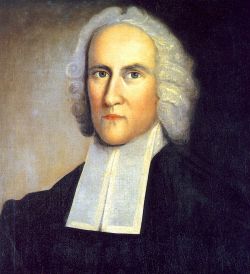
 Asking someone to define Jonathan Edwards’ historical and theological legacy can vary from person to person. There is no denying that Edwards was a towering force of intellectual influence in his day. Sadly our public schools have not been kind or fair to him. They greatly underplay his contributions to science and philosophy and wrongly stereotype him as nothing more than a fundamentalist, hell fire and brimstone preacher during the 1st Awakening. He is largely ignored in our public textbooks today and that is unfortunate. While I had long known that Edwards was the founder of Princeton, I was surprised to recently discover that he was also somewhat socially progressive for his time in advocating that Indians be compensated for land taken from them– which placed him in hot water with some of his New England parishioners.
On the other hand Edwards demonstrated an unnerving talent to be thoroughly inconsistent– for Edwards was also a slave owner! And herein is where the center of my critique will largely focus. Whereas America’s public educational sector underplays Edwards legacy, I believe many Christians–particularly Calvinists– overplay his legacy as being the height of godly virtue and a figure whose life and theology ought to be emulated and followed. It is not my intention to disparage Jonathan Edwards or smear his reputation. There is no doubt Edwards was a great man, a loving father, passionate pastor and a devoted follower of the Lord who faithfully served God in his generation. Sectors of the church today owe him a huge debt of gratitude, for they are building on a foundation first laid down by Edward’s perseverance unto God’s glory.
With that said I find it somewhat troubling that Edwards has largely been given a pass on both his logical and biblical flaws in theology as well as his slave ownership. I am not troubled on the basis that Edwards’ sins and flaws have been forgiven by Christians today. Indeed we all have flaws and we all need to generously grant each other the “love that covers over a multitude of sins” (1 Pet. 4:8). Rather I am troubled by the fact that few pause long enough to consider the strong possibility that Edwards’ Calvinistic, theological determinism may have exerted a strong influence on his decision to unapologetically defend slave ownership– or at minimum blinded him to the horror of being complicit in such a social evil. Edward’s Calvinistic theology led him to believe that everything that occurs in the world is exactly as God predestined it to be–including slavery. The perennial question that plagues Calvinism and which Edwards must have wrestled with is: “What God has predestined has he not more or less condoned?”
Indeed any true Calvinist who wants to distance himself from a particular societal evil and question its moral rightness, must somehow annul himself from all logic that would throw the question back into his face and force him to answer why its logically right to morally question and abhor what God has allegedly divinely determined. Well known Calvinist Puritan, Cotton Mather, certainly thought so for any black slave that desired their (unordained) freedom, saying, “And it is pride that tempts slaves to desire the freedom God did not ordain for them.” [1]
It is only fair to wonder if Edwards thought the same thing, for he did not own just one slave, he and his family owned numerous slaves. To his credit Edwards did not share the view of other slave holders who saw the African blacks as an inferior people or race. Strangely enough Edwards attempted to argue that while all men, including African slaves, are our equal neighbors and possibly even our equal brothers and sisters in Christ in the Kingdom of God, it was not at all sinful to use one’s African “neighbors’s work without wages” in a slave context. [2] For a man much touted by Calvinists as being the exemplar and paradigm of Christian thought, Edwards moral and theological compromise must give us pause.
Roughly a hundred years later, this same absurd notion (forcing one’s neighbor to work without pay is not counter Kingdom) would be articulated by the prominent Calvinist minister, Richard Fuller, one of the principal founders of the Southern Baptist Convention in 1845. He asks, “Is it… a crime for men to hold men in a condition where they labor for another without their consent or contract?” Fuller emphatically argues no, stating, “the crime is not slaveholding, but cruelty.” Fuller then goes on to astonishingly declare that nothing in the N.T. (regarding the inauguration of the Kingdom of God) argues against holding a fellow human being in bondage against his will, because slavery is not the right to cruelly abuse another. Rather “slavery is bondage, and nothing more… only a right to his service without consent…”[3] You can’t make this stuff up if you tried! Apparently neither Edwards nor Fuller saw any reason to think holding one’s neighbor or fellow Christian brother in human bondage was by its very nature antithetical to the Kingdom of God set forth in Christ’s words “I have come to proclaim freedom to the prisoners… to set the oppressed free” (Lk. 4:18).
Despite his many wonderful attributes, Edwards was staggeringly blind to how his life-long unapologetic support for domestic slave ownership was inconsistent with the Kingdom of God. As the conscience of North America became awakened to the evils of slavery and voices began to speak out against its insidious nature, Edwards strangely sought to defend it. At one point Edwards defended a fellow minister named Doolittle whose congregation wanted to oust him because he was too lavish in his lifestyle, was suspected of being an adherent of Arminianism (a label he largely denied), but above all– that he was a slave owner. [4]
 This is rather interesting because some seek to defend Edward’s slave ownership on the grounds that America, despite her spiritual awakening, had not yet begun to awaken to the injustice and evil of slavery. However this is simply not true. It certainly wasn’t true for Doolittle’s congregation! They sought to dismiss Doolittle on the basis of slave ownership while Edwards sought to defend him on the basis that it was not inherently wrong to make any slave “work without wages.”
Truth be told, the mid 17oo’s were years of great spiritual awakening and as the movement began to spread critics of slavery began to draw upon it as a foretaste of the glorious Kingdom to come– a Kingdom in which slavery had no place. As such slavery ought now to be abolished from the Christian community. However Edwards disagreed.
Massachusetts historian Minkema Kenneth explains: “Doolittle’s critics apparently repeated claims that the revivals marked the beginning of these glorious times as an argument that slave owning was no longer tolerable. Edwards, more realistically, had to allow that “things” were not yet “settled in peace,” and so the fallen world’s order, which for him included slavery, was still in effect.” [5]
It is actually logically consistent of Edwards to hold this because Calvinism holds that all the affairs of the world are predetermined by God. As such the affairs in the world do not change until the time preordained for them to change comes to pass. Apparently Edwards felt that such a change for the black man in America was not yet upon the stage of the world, and therefore God’s predestination of the enslavement of the black man was still in effect. There is little else one can conclude from Edwards’ remarks.
For example in examining Edward’s sermon notes for, “Christian Liberty” Minkema Kenneth notes that Edwards opening sentence originally stated that when the Messiah came “he should proclaim a universal liberty to all servants, slaves, captives, vassals, [and] imprisoned [or] condemned persons.” But before he stood up to deliver his sermon Edwards evidently had second thoughts and “went back and, in an apparent tactical withdrawal, deleted the word “slave” from this litany. All the same, the Messiah was not yet come; the time of jubilee had not arrived, nor would it likely come for some time, and until then slavery was sanctioned.” [6]
The fact of the matter is that a Calvinist must shelve his belief about God’s unconditional, meticulous determination of all things in order to condemn anything as “against God’s will.” Apparently Edwards was a true believer to the end because he did not will his slaves free upon his death. Perhaps he felt the time would come  that America’s domestic use of slaves would end, but if that day did come it would be a result of a new era in God’s preordination coming to pass. It would appear that Edwards felt that until that time came it was not wrong to subject one’s black neighbor to slavery and he remained an unapologetic defender of America’s domestic slave trade until his death.
On a side note, many have pondered why Edwards, who zealously opposed Arminianism, would be willing to come to the aid of a minister who was suspected of having Arminian leanings. It could be that upon discussions with Doolittle, Edwards was satisfied that his theology was not suspect. But it is more likely the case that Edwards felt so strongly that a congregational threat to a fellow minister on the basis of lavish living and slave ownership was a threat against his own livelihood as a slave owning minister. In fact within a few short years in 1744, “a number of his parishioners insisted upon an account of his own expenditures, an action suggesting the jealousy and resentment aroused by the family’s taste for jewelry, chocolate, Boston-made clothing, children’s toys—and slaves.” [7]
Again it is not my intention to be uncharitable and unfair to Edwards. I’m not here to judge anyone because they bought chocolate and toys for their kids. Edwards had eleven children and if he had a whole room full of toys I would not think him any less of a man! But history is history and it reveals that he was at odds with certain members in his congregation over his personal ownership of slaves. As alluded to earlier the most troubling feature of Edward’s legacy is the fact that he did not will freedom to his slaves upon his death– something which was not at all uncommon in his day as America’s moral conscience began to awaken in the North. In fact Doolittle later had the last word against his detractors by relenting of slave ownership, freeing his one slave Abijah Prince and generously granting him his legacy and his personal land title estates in Northfield–which truly was unheard of at that time! [8]
Strangely enough Edwards, the voice of America’s spiritual awakening, sought to defend America’s domestic slavery of Africans while at the same time denouncing the Transatlantic slave trade that was decimating many African countries in bringing slaves to America. The disparate thinking of Edwards and his abject failure to see how one could not have existed without the other is thoroughly bewildering.
Thabiti Anyabwile, himself a present day Calvinist theologian, sums it up well, saying, “Edwards attempted to thread a needle between ending the Transatlantic slave trade, on the one hand, and supporting the domestic servitude of Africans on the other. When he wrote the congregation in defense of Doolittle, he chided them for their hypocrisy, for condemning slavery but enjoying the fruits of slave economy. Perhaps it’s fitting to simply state: It takes a hypocrite to know a hypocrite. Or, more charitably, Edwards saw the inconsistency of others more clearly than he saw his own in this case.” [9]
One more note on Edward’s misgivings of the Transatlantic slave trade bears mentioning. Edwards purchased one of his slaves, a 14 year old girl named Venus, from the captain of an African slave trader ship in New England. [10] But to be fair to Edwards his purchase of Venus was made in 1731 and presumably before he deemed the Transatlantic slave trade to be wrong. So why didn’t he later release Venus, his purchased Transatlantic-African slave girl, once his feelings on the African slave trade evolved? Why have her be held in the grip of slavery up until his death? We cannot press this point too strong. It is uncertain if Venus was still a household slave in family’s possession upon his death. Information is scarce and while some of his personal slaves are mentioned in later documents, the name Venus is not mentioned. But that may be because he gave her a Christian name, or she could have died young while enslaved. Another possibility is that he sold her or traded her in for another female slave, such as Leah or Sue, two other slaves that show up in documents.
While there is much virtue in the man–well beyond my own– to be praised and admired, I find it interesting and a bit telling that leading Calvinists like Edwards as well as George Whitfield supported and defended America’s enslavement of blacks and were totally blind to how such support was inconsistent and diametrically opposed to the character of God as revealed through Christ. Was there something more going on beyond mere cultural contamination blinding them?
I believe so. I believe there was theological contamination. For Calvinists adopting inconsistent views that run afoul of God’s character is nothing new. Calvinism has long been criticized for its stiff-necked embrace of incoherent contradictions and inconsistencies concerning the character of God and then appealing to “inscrutable mysteries” every time they are challenged to unravel their self-contained conundrums. Conundrums like how God’s mind can be the logical origin of every person’s sin in virtue of decreeing each sin, and yet not be the author of the very sins he unilaterally decrees.
This leads to another issue, and that is Edwards’ theologically bankrupt position in condemning the Transatlantic slave trade. It has already been highlighted how Edwards hypocritically approved of and supported the continuance of America’s domestic slave trade but was disenchanted with the Transatlantic merchant ship slave business– the same business that fathered America’s domestic slave trade of which he approved. But that aside it is additionally beyond bewildering that Edwards would attempt to condemn any practice as “wrong for the world” when his theology mandates the view that God sovereignly preordained and rendered certain all the social evils of that present world– such as the Transatlantic slave trade that he finds fault with and denounces! This is cognitive dissonance par excellence.
 As alluded to earlier, the question begs to be asked: How is it logically right for any Calvinist, like Edwards, to condemn what God has allegedly divinely determined? How is logically right for any Christian to seek to put to rights and redress the very evils God has sovereignly instituted should be part of the fabric of our world? Would it not be to put one’s self in the position of fighting against Almighty God? For many Calvinists such a question asks far too much of them to reflect upon. More on this soon.
But first a little disclaimer is in order. It is impossible and indeed misguided to attempt to denounce the merits of Calvinism or extol the virtues of Arminianism solely on the basis of whose historical theologians had more slaves– for there will always be exceptions. However it cannot be denied that the early, “trailblazing” abolitionists in the Church were by and large Arminians– men like Wesley, Asbury, Wilberforce and Finney. John Wesley and Jonathan Edwards were both born in the same year, 1703, and Wesley in particular was not at all a “product of his time” and passionately spoke out against the evils of British and colonial American slavery in tract and speech. And he did so on the grounds that slavery was antithetical to Christ’s death which procured freedom for all and his desire to have mercy on all– as taught in Arminianism. [11] One will not find greater reasons to condemn the unjust enslavement of one’s neighbor and advocate for the freedom of all. Sadly such divine tenants are glaringly absent in Calvinist theology.
Moreover I find it troubling that Wesley’s contemporaries on the other side of the theological spectrum, Edwards and Whitefield, not only owned many slaves but advocated for slavery to continue at a time when many were questioning the morality of holding their fellow human being in dehumanizing bondage. But the larger question I find myself pondering is, should it really be all that surprising to us that principal, Arminian leaders like Wesley, Asbury, Wilberforce and Finney opposed slavery– and did so on Arminian theological grounds?
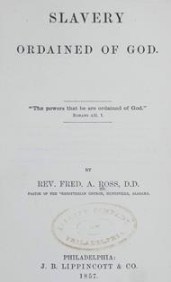 Moreover should we simply consider it a strange anomaly that Calvinist leaders like Mather, Edwards and Whitefield, who preached God’s determinative decree of all things (which necessarily must include slavery) should then be seen to approve of slavery? Should it really surprise us that Calvinist leaders of the Southern Baptist Convention defended slavery–and did so on Calvinist theological grounds, with telling title defenses like, “Slavery Ordained by God.” [12] Should it surprise us that white, Afrikaner Calvinists long used their Calvinist theology of unconditional election and God’s meticulous, sovereign predestination of all things as an aid in identifying themselves as God’s special elect in order to justify racial discrimination and eventual apartheid in South Africa?[13]
I would say not. Whether one can admit it or not, the fact is there is very little logical space Calvinism can offer by way of motivation and incentive to put to right the wrongs of the world. If there are what would they be? For in Calvinism nothing can be said to be truly blameworthy because all things–including the evils of slavery–have been decreed by God for his glory. The world is the way it is because God predestined it so. God predestined that whites would be the masters of blacks. Consequently if God didn’t want a black person to be subjected to slavery pre-Civil War he would have sovereignly decreed for them to be white. Given a belief in God’s predestination of all things what other logically consistent conclusion can be drawn if you were a Calvinist in that day?
To their credit many Calvinists did join the ranks of abolitionists in time, but in my opinion that shift in thought was due more to getting caught up in the surrounding culture’s evolution in progressive, enlightenment thinking than to Calvinism per se. This is not to say there did not exist any slave holder who espoused Arminian ideas–there undoubtedly were. But all things considered I think it is accurate to say the pioneers of abolitionism were largely Arminian– and we shouldn’t dismiss this as mere coincidence. Doctrines like God’s universal, redemptive benevolence towards all men, his desire to extend mercy on all, his death to procure the freedom of all and a rejection of meticulous, divine determinism simply provides a greater logical and theological basis to condemn slavery than does Calvinism.
As already noted above, a belief in theological determinism, like that in Calvinism, leaves little room to truly condemn anything or anyone. Again– to give an event in the world your disapproval is to call into question what God has predetermined ought to occur. As such who are you, a mere man, to do that? It would seem much more fitting and proper to acquiesce to all things in view of the fact that God has sovereignly predetermined them. Calvinism’s problem is that what God predestines is so closely aligned to what God condones that a Calvinist must step outside his theology to condemn it and redress it.
Historian and author Douglas Harper explains how Calvinist theology dovetailed with condoning slavery:
“Massachusetts, like many American colonies, had roots in a scrupulous fundamentalist Protestantism. Christianity was no barrier to slave-ownership, however. The Puritans regarded themselves as God’s Elect, and so they had no difficulty with slavery, which had the sanction of the Law of the God of Israel. The Calvinist doctrine of predestination easily supported the Puritans in a position that blacks were a people cursed and condemned by God to serve whites. Cotton Mather told blacks they were the “miserable children of Adam and Noah, “for whom slavery had been ordained as a punishment.” [14]
To be fair we can commend Whitefield in speaking out against the excessive mistreatment of slaves in his day and for promoting the belief that black slaves also had souls of value and therefore should be evangelized and even educated (a progressive view in Georgia). However at the end of the day Whitefield opted for moral and theological compromise because he felt the economy of Georgia needed the backs of slaves to hold it up. After acquiring his own plantation and buying numerous slaves Whitefield became one of the most vocal proponents to reintroduce slavery to Georgia after it was banned.
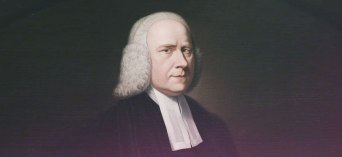 In a day when a growing tide of moral conscientiousness began to call into question the morality of slavery Whitefield actually traveled throughout Georgia advocating for slavery to be allowed to continue. In 1749 slavery was indeed outlawed in Georgia, but Whitefield saw this as an economic travesty and intentionally campaigned for it to be legally legislated once again! Historians agree that Whitefield’s pro-slavery campaigns and written pleas to the Georgia Trustees advocating for the necessity of slavery were instrumental in overturning the law of 1749, resulting in the enslavement of blacks being reintroduced to Georgia in 1751. The following selection from a letter Whitefield wrote to an associate is an astounding example of how a great man can become so self-deluded as to use spiritual sentiments to justify the moral bankruptcy of bigotry and slavery:
“Though liberty is a sweet thing to such as are born free, yet to those who never knew the sweets of it, slavery perhaps may not be so irksome. However this be, it is plain to a demonstration, that hot countries cannot be cultivated without negroes. What a flourishing country might Georgia have been, had the use of them been permitted years ago? How many white people have been destroyed for want of them, and how many thousands of pounds spent to no purpose at all? Had Mr Henry been in America, I believe he would have seen the lawfulness and necessity of having negroes there. And though it is true, that they are brought in a wrong way from their own country, and it is a trade not to be approved of, yet as it will be carried on whether we will or not; I should think myself highly favoured if I could purchase a good number of them, in order to make their lives comfortable, and lay a foundation for breeding up their posterity in the nurture and admonition of the Lord.” [15]
Like Edwards, Whitfield’s thinking was plagued with morally entangled inconsistencies that cannot be unraveled or justified. Whitefield’s defenders may counter that it is recorded that his slaves were devoted to him, or that Whitefield saw his role as their master as an opportunity to be their evangelist too. But such sentiments cannot excuse the fact that Whitefield’s actions in advocating that a “hot country” like Georgia needed slaves to be “a flourishing country” helped to consign thousands of blacks to a future enslavement whereby many suffered under cruel masters who did not share Whitefield’s view in “making their lives comfortable, and lay a foundation for breeding up their prosperity in the nurture and admonition of the Lord.” What is most astonishing is that Whitefield laments the fact that slaves weren’t introduced into the hot, Georgian farmland earlier, saying, “What a flourishing country might Georgia have been, had the use of them been permitted years ago? How many white people have been destroyed for want of them…”
 In contrast to Whitefield, John Wesley, who also lived in Georgia for a time always opposed slavery and called America’s enslavement of the blacks, “that execrable sum of all villanies.” [16]
I find it profoundly touching that the last letter Wesley wrote before he died was to William Wilberforce who was converted under his ministry. In the letter a frail and sickly Wesley seeks to encourage his friend to stay the course and not give up on his mission to purge the British Empire of the sinful scourge of slavery. He writes:
Dear Sir:
Unless the divine power has raised you us to be as Athanasius contra mundum, I see not how you can go through your glorious enterprise in opposing that execrable villainy which is the scandal of religion, of England, and of human nature. Unless God has raised you up for this very thing, you will be worn out by the opposition of men and devils. But if God be for you, who can be against you? Are all of them together stronger than God? O be not weary of well doing! Go on, in the name of God and in the power of his might, till even American slavery (the vilest that ever saw the sun) shall vanish away before it. [17]
Recently Roger Olson wrote a critique of Edwards legacy. Olson also rightly argues that while the American public school system has wrongly downplayed Jonathan Edwards contributions, American evangelicalism has overblown his legacy as being America’s greatest preacher and theologian that we should emulate and follow. Olson believes that Edwards has become the darling of Christian thought for many evangelicals due in no small part to receiving a “pass” on many of his unfortunate logical and theological blunders– not to mention his glaring hypocrisy in defending slave ownership. But the substantive meat of the article is Olsen’s keen insight in skillfully dissects Edwards theology and reveals his logical inconsistencies and tantamount theological blunders that make his underlying theology wholly untenable for Christian thinkers to embrace. The following is a section of Olson’s critique. (For the full article please go here.)
“Without doubt, Edwards was a great man and deserves more and better respect than he gets in American public education.
Having said all that, I still do not understand why so many of his fans overlook or excuse Edwards’ very significant errors. I can identify with Charles Finney who said of Edwards “The man I adore; his errors I deplore.” It seems to me that many of Edwards’ fans (especially among American evangelicals) are too quick to pass over the obvious logical flaws in his theology.
For example (and here you will have to trust me or look at my chapter on Edwards in The Story of Christian Theology and my many allusions to him and his theology in Against Calvinism): Edwards argued that God’s sovereignty requires that he create the entire universe and everything in it ex nihilo at every moment. That goes far beyond garden variety creation ex nihilo or continuous creation. It is speculative and dangerous. He also asserted that God is space itself. And he came very close to denying that God’s creation of the world was free in any libertarian sense as if God could have done otherwise. (He said that God always does what is most wise, something with which few Christians would argue, but somehow one must admit the possibility that God might not have created at all. Otherwise the world becomes necessary even for God which undermines grace.)
All of those ideas can perhaps be dismissed as the speculations of a mind obsessed with God’s greatness, glory and sovereignty. But things get much, much worse when Edwards deals with free will. Free will, according to him, only means doing what you want to do–following the strongest inclination provided to the will by the affections. It does not mean being able to do otherwise. In fact, Edwards seemed to deny the whole idea of “otherwise”–even in God. He did not merely argue that libertarian free will as ability to do otherwise was lost in the fall; he argued that the very idea is incoherent. If that’s true, then we cannot attribute it to God, either. And the fall becomes not only inevitable but necessary.
The question that naturally arises is: from where did the first evil inclination come? Edwards claims a creature formed it; it arose from a creature’s (Lucifer’s and later Adam’s) own nature. God simply “left ‘em to themselves” so that sin and evil followed inevitably or necessarily. That is to say that God withdrew or withheld the grace creatures needed not to sin. God rendered the fall and all its horrible consequences inevitable or even necessary. And yet, creatures are to blame for sinning even thought they could not do otherwise.
Edwards wanted to get God off the hook for being the author of sin and evil, but ultimately he couldn’t. And he didn’t draw back from admitting that IN SOME SENSE God is the author of sin and evil. But he insisted that God is not guilty of sin or evil because…God’s motive in rendering them certain was good.
Now, let’s stop and examine this line of reasoning a bit. First, the very idea of libertarian free will is incoherent so even God cannot have it. God, too, is controlled by his strongest inclination/motive. Where do God’s inclinations come from? If one says “from his nature,” then, with the denial of libertarian free will, God becomes a machine. Everything God does is necessary–including rendering sin and evil certain. And why does God render sin and evil necessary? For his glory. (See Edwards’ Treatise Concerning the End for Which God Created the World.) So, sin and evil are necessary and serve God’s glory.
And yet, Edwards insisted that God abhors sin and evil. Why? If they are determined by his wisdom and necessary for his glory, why would he abhore them? Edwards tried to resolve this by appealing to God’s larger and narrower views. In the grand scope of things, seen from the widest perspective possible, sin and evil are part of the grand scheme of God to glorify himself. On the other hand, in the narrower perspective, God abhors them and commands creatures not to do them. And punishes them with eternal suffering for doing what serves his glory and is necessary.
Need I go on making my case that Edwards’ theology contains massive flaws? The single greatest flaw is the character of God. This inevitably makes God the author of sin and evil (something Edwards reluctantly admitted) and makes sin and evil not really awful at all but necessary for the greater good. It’s not just that God brings good out of them. For Edwards they are necessary for God’s full glorification.
Now don’t anyone say “Only in this creation; not overall or in general.” That won’t work. This creation is necessary if God does not have libertarian free will which he cannot have if the concept itself is logically impossible (incoherent).
In attempting to pay God too many and too large metaphysical compliments, Edwards ends up chasing his tail and contradicting himself. Is that the mark of a great mind? Well, I’m not saying he didn’t have a great mind. I’m only saying that he either didn’t seem to notice his own contradictions or he chose to overlook them while vehemently pointing out and condemning contradictions he thought he saw in Arminianism. [18]
[4] Doolitttle rejected the label Arminian, saying, “I am no papist to make either Calvin or Arminius
my pope to determine my Articles of faith for me.” See: Minkema, Kenneth. Massachusetts Historical Review Vol. 4, Issue NA. p.32
[5] Minkema, Kenneth. Massachusetts Historical Review Vol. 4, Issue NA. p.29
[6] Minkema, Kenneth. Massachusetts Historical Review Vol. 4, Issue NA. p.34
[7] Minkema, Kenneth. Massachusetts Historical Review Vol. 4, Issue NA. p.24
[8] Minkema, Kenneth. Massachusetts Historical Review Vol. 4, Issue NA. p. 37
[11] Note Wesley’s Arminian anchor points for denouncing slavery: “O thou God of love, thou who art loving to every man, and- whose mercy is over all thy works; thou who art the Father of the spirits of all flesh, and who art rich in mercy unto all; thou who hast mingled of one blood all the nations upon earth; have compassion upon these outcasts of men, who are trodden down as dung upon the earth! Arise, and help these that have no helper, whose blood is spilt upon the ground like water! Are not these also the work of thine own hands, the purchase of thy Son’s blood? Stir them up to cry unto thee in the land of their captivity; and let their complaint come up before thee; let it enter into thy ears! Make even those that lead them away captive to pity them, and turn their captivity as the rivers in the south. O burst thou all their chains in sunder; more especially the chains of their sins! Thou Saviour of all, make them free, that they may be free indeed!” -John Wesley, “Thoughts upon Slavery”, 1774. See: http://www.umcmission.org/Find-Resources/Global-Worship-and-Spiritual-Growth/The-Wesleys-and-Their-Times/Thoughts-Upon-Slavery
Further thoughts on the matter are helpful. It is true that disagreement over slavery did not only split the Baptist Church but also the Methodist church along North and South lines. However southern, Methodist clergy (largely Arminian) did not defend slavery as an institution sovereignly decreed by God, as their fellow Calvinist Baptists were often prone to do. Rather southern Methodists who opted to defend slavery did so on the grounds that it was a states right issue. Their Calvinist, Southern Baptist compatriots took it a step further and defended slavery along theological lines–chiefly God’s sovereign foreordination of all things. Two well-known sermons from Calvinist Baptist preachers during the Civil War bear this out. On January 27, 1861, standing before a packed house Ebenezer W. Warren, pastor of the First Baptist Church of Macon, Georgia, gave a stirring message in defense of God’s ordination of slavery entitled “Scriptural Vindication of Slavery.” He is quoted as declaring, “Both Christianity and Slavery are from heaven; both are blessings to humanity; both are to be perpetuated to the end of time …. because their Maker has decreed their bondage, and has given them, as a race, capacities and aspirations suited alone to this condition of life ….”
On August 21, 1863, Isaac Taylor Tichenor, one of the most influential (Calvinist) Baptist ministers of his day, and who also fought in the bloody battle of Shiloh, was asked to give prepare sermon that would be delivered before the General Assembly of the State of Alabama. He invokes Calvinism’s view of meticulous divine sovereignty throughout his sermon to exhort his listeners to bear in mind that God was governing the war against the South’s wicked foes who would seek to subvert her freedom and remove her institution (slavery). Note his following remarks seeded throughout his sermon: “The continuance of this war does not depend upon the result of battles, upon the skill of our generals… but upon the will of our God… If God be not the Sovereign Ruler of the universe, then the sacrifice of His Son would have been almost in vain… there sits enthroned in inscrutable majesty the Power that moves and controls the world, and that power is God’s…If God governs the world, then His hand is in this world in which we are engaged. It matters not that the wickedness of man brought it upon us…to deprive us of our rights and institutions [slavery]… God in His own way will save our Southland… the day has come that he will vindicate His long ignored rights as Sovereign of the world.” See https://archive.org/details/isaactaylortic00dill p. 89-101 Tichenor believed one reason God was sovereignly delaying the victory of the South was that the South had too much pride “in the bulwarks of self-confidence” and was not demonstrating enough reliance on prayer and “reliance on God.” He saw this in part as the South ignoring God’s rights as Sovereign over the world. One wonders what this means? Tichenor has stumbled into the perennial absurdity of Calvinistic sovereignty. If God is sovereign in the sense that he is controlling all things, it would necessarily include the dispositions men have to pray or not pray, trust in God or trust in human might. If God sovereignly controls every human event, how then can his sovereignty be ignored by such people–unless of course God sovereignly determines that such people ignore his sovereignty? In what sense does Tichenor’s “Sovereign of the world” lose his rights as “Sovereign of the world” and vindicate himself? The entire construct of Calvinistic divine sovereignty is self-defeating no matter the oratory it is wrapped in or the century it pops up in.
[15] Whitefield, George. Works, volume 2, letter DCCCLXXXVII


 A Theology in Tension